
JCB Fastrac 6300: JCB's Flagship 6000 Series Tractor
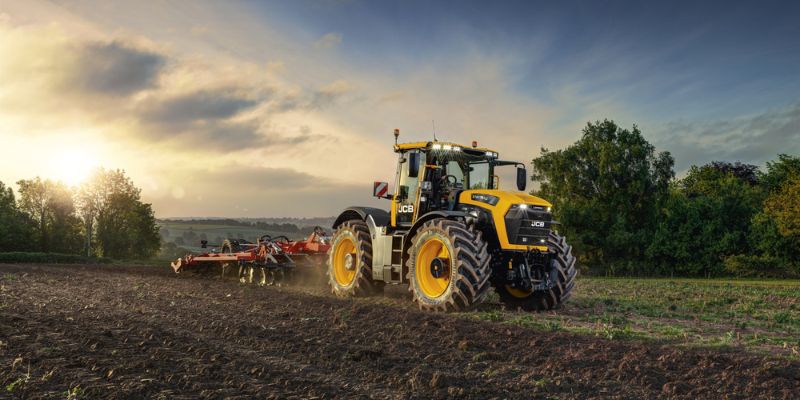
Introducing the JCB Fastrac 6300 Tractor
If your farm or contracting work needs a tractor that can cover serious ground on the road and still put in a full shift in the field, the JCB Fastrac 6300 is worth a look. It's the flagship model in JCB's 6000 Series, built around three things: power, speed and lift capacity.
A few headline numbers to start you off:
● 335hp (250kW) and 1,400Nm of torque from a 6.7-litre FPT engine
● Top speed of 66km/h through a ZF CVT transmission
● 11,000kg rear linkage lift capacity, with an optional 5,000kg front linkage
This is the second full redesign of the JCB Fastrac in over 30 years, and while a lot has changed under the skin, the bits that make a Fastrac a Fastrac are still there: the mid-mounted cab and four-wheel-drive layout that set it apart from a conventional tractor.
JCB has added its Smart Transmission Control software and an integrated guidance system on top, so it feels every bit as modern to drive as it looks.
JCB Fastrac 6300 Specs at a Glance
Specification | Fastrac 6300 |
Rated power | 335hp (250kW) |
Maximum torque | 1,400Nm |
Transmission | ZF ECCOM 3.1 CVT, 4-range automatic |
Top speed | 66km/h |
Rear linkage lift capacity | 11,000kg |
Front linkage lift capacity (optional) | 5,000kg |
Max hydraulic flow (standard/optional) | 205 / 410 l/min |
Rear PTO power | 295hp (220kW) |
Unladen weight (base machine) | 10,810kg |
Fuel tank | 475 litres |
CTIS | Optional |
Power & Performance of the JCB Fastrac 6300
Under the bonnet is:
● A 6.7 litre, 6-cylinder FPT N67 engine, turbocharged and intercooled, putting out 335hp (250kW) at 1,900rpm and a maximum torque of 1,400Nm at 1,500rpm.
● A Bosch common rail injection system and a Powercore dry element air cleaner, with an exhaust brake fitted as standard, so there's plenty in reserve for heavy cultivation work or a full trailer on the road.
● A generous 475 litre fuel tank, alongside a 170 litre hydraulic tank and a 79 litre urea (AdBlue) tank, so you're not stopping to fill up every five minutes.
If you're weighing it up against its smaller sibling, the JCB Fastrac 6260 produces 284hp (212kW) and 1,275Nm. The 6300 also gets the CTIS option that the 6260 doesn't (more on that below).
6300 JCB Fastrac Transmission & Road Speed
Power gets to the ground through a ZF ECCOM 3.1 CVT transmission with 4 automatic ranges, and it'll happily cruise at up to 66km/h, useful if you're covering distance between fields or sites.
JCB's Smart Transmission Control (STC) software takes care of managing the engine and CVT together, so you get smooth, precise control whether you're flat out on the road or easing through a gateway.
You can also switch between joystick, pedal or thumb-roller control depending on what suits the job.
Fastrac 6300 Linkage and Carrying Capacity
The rear 3-point linkage is Category III with quick-attach hook ends (Cat 4-N available if you need it) and lifts up to 11,000kg, with electronic control over depth, draft/position intermix and rate-of-drop.
If you regularly run front-mounted kit too, the optional front linkage (Category IIIN, folding arm) adds another 5,000kg of capacity, so you can genuinely work implements at both ends at once.
On the scales, the base machine weighs 10,810kg unladen (5,570kg on the front axle, 5,240kg on the rear). With rear and front linkage, front PTO, and 710/55R38 tyres, the total machine weight climbs to 12,530kg.
Maximum permissible mass is 18,000kg (9,000kg front axle, 11,500kg rear axle), so there's plenty of headroom for a well-specced machine plus a full load.
Hydraulics & PTO for the Flagship JCB 6000 Series Fastrac
Standard hydraulic flow is 205 l/min, and if you need more, the 6300 can be specified with an optional 410 l/min pump, at 210 bar operating pressure. Up to 7 spool valves can be fitted, split between front and rear, with lever-operated connect-under-pressure couplings, rear free-flow return as standard and optional power beyond load sensing, so it can handle demanding hydraulic implements without breaking a sweat.
Round the back, the PTO is a 4-speed unit with soft engage and electro-hydraulic speed shift, running at 540/1000/540e/1000e rpm and putting out 295hp (220kW) on the 6300. There's an optional front PTO too, running at 1,000rpm, if your setup calls for it.
Featuring High-End JCB Fastrac Cab Comfort & Technology
You'll be spending long days in this cab, and it shows: the mid-mounted layout comes with adjustable display screens, seat and armrest, plus a heated and ventilated seat and automatic climate control as standard on Field Pro and Pro Line specification. Fancy a bit of music while you work? There's an optional AudioPro sound system with a 6.5" subwoofer.
On the technology side, JCB's integrated Guidance system uses dual NovAtel satellite receivers for fast, accurate line acquisition, with automated headland turn guidance and configurable layouts across the main and secondary screens.
ISOBUS compatibility comes as standard on Field Pro and Pro Line specification too, so swapping between implements is straightforward rather than a faff.
Essential 6300 Fastrac Safety & Suspension Features
All four wheels get outboard disc brakes with single callipers and electronic pad wear indicators, with ABS fitted as standard, so stopping power is consistent whatever the conditions.
The park brake is electronically controlled and hydraulically actuated, and trailer brakes apply automatically the moment the tractor's park brake is engaged.
Underneath it all, an advanced double-acting, front and rear hydro-pneumatic self-levelling suspension system with anti-roll bars sits on a full-length rigid chassis, keeping things stable at speed and steady on rough ground.
One thing worth knowing: the 6300 is the only model in the 6000 Series that can be specified with JCB's Central Tyre Inflation System (CTIS), an integrated single-line, blast-cooled system that lets you adjust tyre pressure from your seat at the touch of a button. Drop the pressure in the field for better traction and less soil damage, then bring it back up for the drive home and you'll notice the difference in fuel and tyre wear.
Who is the JCB Fastrac 6300 suited to?
If you're running a mixed or general farming operation and want one tractor to earn its keep across a wide range of jobs, from heavy cultivation and trailer work through to a fast run down the road, the 6300 is built with exactly that in mind.
Its 66km/h road speed and CTIS option suit operations covering larger distances between land, and with linkage and PTO at both ends plus up to 7 spool valves, it can run front and rear implements together rather than making you choose.
Chat To the JCB Experts at Scot Agri
Don't just take our word for it! See the Fastrac 6300 in action by getting in touch with your local Scot Agri depot. We'd be happy to talk you through the full machine specifications and arrange a personal demonstration.
Start a conversation with our JCB tractor specialists today!
FAQs
What is the top speed of the JCB Fastrac 6300?
The JCB Fastrac 6300 has a top road speed of 66km/h. This comes from a ZF ECCOM 3.1 Continuously Variable Transmission (CVT) with four automatic ranges, managed by JCB's Smart Transmission Control (STC) software, which coordinates the engine and CVT together for smooth, precise control at any speed. For agricultural applications, that means less time lost travelling between fields or sites, and finer control when you're easing through a gateway or working at low speed in the field.
What engine is in the JCB Fastrac 6300?
The Fastrac 6300 is powered by a 6.7-litre, 6-cylinder FPT N67 engine. It's turbocharged and intercooled, producing a maximum output of 335hp (250kW) at 1,900rpm and 1,400Nm of torque at 1,500rpm, fed through a Bosch common rail injection system.
Does the Fastrac 6300 have a Central Tyre Inflation System (CTIS)?
Yes, the Fastrac 6300 can be specified with JCB's factory-fitted CTIS. It's a blast-cooled, single-line system that lets you adjust tyre pressure from the driver's seat at the touch of a button, dropping pressure in the field for better traction and less soil damage, then bringing it back up for the drive home to save on fuel and tyre wear. It's a genuine talking point for the 6300, as it's the only model in the 6000 Series available with CTIS.
What's the difference between the Fastrac 6260 and 6300?
The primary differences between the Fastrac 6260 and 6300 are engine output, hydraulic options, and tyre technology. The 6260 produces 284hp (212kW) and 1,275Nm of torque, against 335hp (250kW) and 1,400Nm on the 6300. The 6300 can also be specified with the optional 410 l/min high-flow hydraulic pump, on top of the standard 205 l/min shared by both models, and it's the only model in the series that offers CTIS.
Does the Fastrac 6300 need AdBlue (DEF)?
Yes, the Fastrac 6300 requires AdBlue. To meet modern emissions standards, the FPT N67 engine relies on a urea (AdBlue) system, with a 79 litre urea tank sitting alongside the 475 litre fuel tank.
What is the lifting capacity of the Fastrac 6300?
The rear linkage lift capacity of the Fastrac 6300 is 11,000kg, using a Category III 3-point linkage with quick-attach hook ends (Cat 4-N available). An optional front linkage (Category IIIN, folding arm) adds a further 5,000kg, with electronic raise/lower control and double-acting, single-acting or float functions. The two can be run together, so you can work implements at both ends of the tractor at once rather than choosing one or the other.
How much does a JCB Fastrac 6300 weigh?
The unladen base weight of the JCB Fastrac 6300 is 10,810kg. Fully specified, with rear and front linkage, front PTO and 710/55R38 tyres fitted, that rises to 12,530kg. Maximum permissible mass is 18,000kg, giving a well-